 EN
 עברית
 Español
 Français
 Deutsch
 Português
Vietnam Backpacking Route: 4 Weeks North to South
A four-week north to south Vietnam backpacking route, Hanoi to Ho Chi Minh City: nights per stop, trains and buses, weather by region and the e-visa.
Free on the App Store: plan trips, track visa days
The usual Vietnam backpacking route runs the length of the country in about four weeks. Start in Hanoi, with an optional night-train loop to Sa Pa, then go south to Ninh Binh. In the centre, stop in Hue and then Hoi An, using Da Nang as the transport hub. Finish with Da Lat or Nha Trang, then Ho Chi Minh City, with two optional nights in the Mekong Delta. Vietnam Railways' north-south trains cover the long legs, and you go by road to the stops off the line.
Below is the plan we'd build in NomadPoint for that route, step by step. It's an example plan, not a trip report.
Disclosure: we make NomadPoint. Facts checked on 4 November 2026.
The route at a glance
| # | Stop | Nights | How you get there |
|---|---|---|---|
| 1 | Hanoi | 3 | Fly into Hanoi |
| 2 | Sa Pa (optional) | 2, plus 2 on night trains | Night train Hanoi to Lao Cai, then road up to Sa Pa |
| 3 | Ninh Binh (or a Ha Long Bay cruise) | 2 | Road from Hanoi |
| 4 | Hue | 3, plus 1 on the train | Overnight north-south train |
| 5 | Hoi An (via Da Nang) | 5 | Heritage train Hue to Da Nang, then road |
| 6 | Da Lat or Nha Trang | 2 to 3 | Day train from Da Nang to Nha Trang; road up to Da Lat |
| 7 | Ho Chi Minh City | 4 | Night train from Nha Trang, or road or air from Da Lat |
| 8 | Mekong Delta (optional) | 2 | Road from Ho Chi Minh City |
That adds up to about 27 nights with every optional stop included, or about 23 without Sa Pa and the Mekong. Either way there's room for a lost day or two.
Each leg
Hanoi (3 nights)
Start in the north because the long-distance trains start there. Use three nights for the Old Quarter and the lakes, and to get used to the traffic. Book the next two legs from here: the night train north if you're doing Sa Pa, and the overnight train south to Hue.
Sa Pa loop (optional, 2 nights plus 2 on trains)
Vietnam Railways runs three overnight trains a day from Hanoi to Lao Cai, the station for Sa Pa. On the timetable it published on 12 October 2026, SP3 leaves Hanoi at 22:00 and gets to Lao Cai at 05:50. On the way back, SP4 leaves Lao Cai at 21:50 and reaches Hanoi at 05:40. Sa Pa itself is up the mountain from the station by road.
If you'd rather do the Ha Giang loop, there's no railway to Ha Giang, so it's road only. Plan it as a separate block of nights in place of Sa Pa, not as well as Sa Pa.
Ninh Binh or Ha Long Bay (2 nights)
Ninh Binh is the easier one to fit in: it's a short road trip south of Hanoi, and it's on the railway. Ninh Binh is a station in Vietnam Railways' booking system, so you can look for a southbound train from there rather than going back to Hanoi. Check which trains call there on your date. Ha Long Bay is east of Hanoi and off the line south, so it means a detour. Pick one of the two; doing both adds days of transfers.
Hue (3 nights, plus 1 on the train)
The Reunification Express is the name for the SE trains that run the full line between Hanoi and Saigon. On the summer 2026 timetable published by Vietnam's Ministry of Construction, five pairs ran daily (SE1/2 to SE9/10). SE3, for example, left Hanoi at 19:20 and SE1 at 21:45. Times change by season, so check the Hue arrival time for your date on dsvn.vn before you book a room. It's an overnight run, so book a sleeper berth.
Hoi An, via Da Nang (5 nights)
Between Hue and Da Nang, take the "Central Heritage Connection" train. Vietnam Railways says it takes about three hours. It runs past the Tam Giang and Cau Hai lagoons, Lang Co bay and the Hai Van pass, and the summer timetable listed two pairs a day. Hoi An has no station, so you continue by road from Da Nang.
Five nights is generous on purpose. This is the stretch where people slow down, and if you want to work for a week, our Da Nang digital nomad guide covers staying longer.
Da Lat or Nha Trang (2 to 3 nights)
Here you choose between the mountains and the beach. Nha Trang is on the main line. The SE21 day train from Da Nang to Saigon runs through it (summer timetable: Da Nang 07:55, Saigon 04:35 the next morning). From Nha Trang, the SNT1 sleeper left at 20:20 and reached Saigon at 05:00.
Da Lat has no main-line train. Its only passenger service is the short tourist line from Da Lat to Trai Mat. On this route you'd go up by road from Nha Trang and leave by road or by air.
Ho Chi Minh City (4 nights), and the Mekong (optional, 2 nights)
Fly home from here. If you add the Mekong Delta, base yourself there for two nights by road rather than doing it as a day trip, then come back to the city before your flight.
Weather and timing: three climates on one route
Vietnam's north, centre and south have their wet seasons at different times. That's the main thing to plan around. The monthly averages below come from the World Meteorological Organization's World Weather Information Service.
| Wettest months (mean rainfall) | Driest months | |
|---|---|---|
| Hanoi | July 300 mm, August 335 mm | December 24 mm, January 28 mm, February 19 mm |
| Da Nang | October 658 mm, November 486 mm | February 22 mm, March 36 mm, April 50 mm |
| Nha Trang | October 325 mm, November 400 mm | February 13 mm, March 39 mm |
| Ho Chi Minh City | September 273 mm, plus 200+ mm every month May to October | February 8 mm, January 12 mm, March 18 mm |
February to April suits the whole route best, because all three regions are near their driest. Hanoi is cool at the start, with mean highs of 20 to 21°C in January and February.
October and November are the hardest months. The north is dry, but the central coast is at its wettest just when you'd reach Hue and Hoi An. If you're starting this month, give the central leg spare nights or swap the order.
June to August is wet in Hanoi and Ho Chi Minh City and drier in Da Nang.
Entry: the Vietnam e-visa
Vietnam's official e-visa portal says the e-visa is valid for up to 90 days, single or multiple entry. The fee is 25 USD for single entry and 50 USD for multiple entry. You pay through the portal, and the fee isn't refunded if the visa is refused. You have to enter and leave through one of the international border gates on the government's designated list. Four weeks fits easily inside 90 days.
Some passports don't need a visa at all for shorter stays, and the portal links to the list of exemptions. Check yours before you pay, and don't use paid "visa agent" sites that look official.
How we'd set this up in NomadPoint
NomadPoint runs on iPhone, iPad, Mac and Apple Watch. This is how we'd enter the route:
- Create one journey, "Vietnam, north to south", and add the stops in order: Hanoi, Sa Pa, Ninh Binh, Hue, Hoi An, Da Lat or Nha Trang, Ho Chi Minh City.
- Add your passport. NomadPoint shows whether Vietnam needs an e-visa or is visa-free for that passport, checks your passport's validity against the trip, and counts days left once you're in the country. If you hold two passports, it shows the rules for both.
- Add the long-haul flights in and out. With Pro, those get delay, gate and cancellation alerts and a travel-day Live Activity.
- Add each stay as a date range. The timeline marks any night without a stay. On this route that usually means a night train you forgot to enter as a night, or a night after an early arrival.
- Fill in the legs between cities. Each hop between stops gets routes, fares and the apps to buy tickets, so you can see which legs are trains and which are road.
- Forward booking emails to build the rest, and keep the e-visa PDF, insurance and boarding passes in Documents. The whole itinerary is available offline, which helps on trains through the mountains.
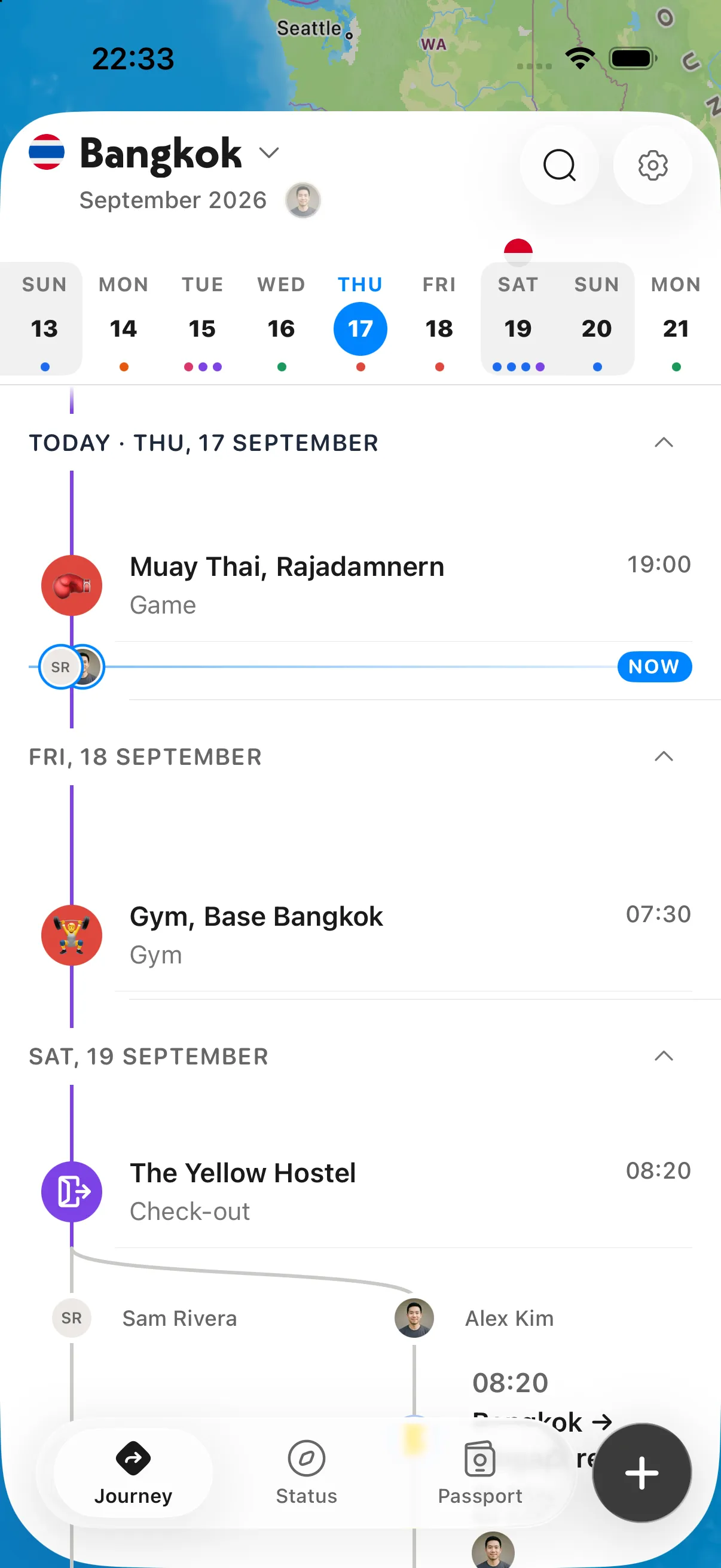
A NomadPoint screen with example data: a journey shown on the map, stop by stop.
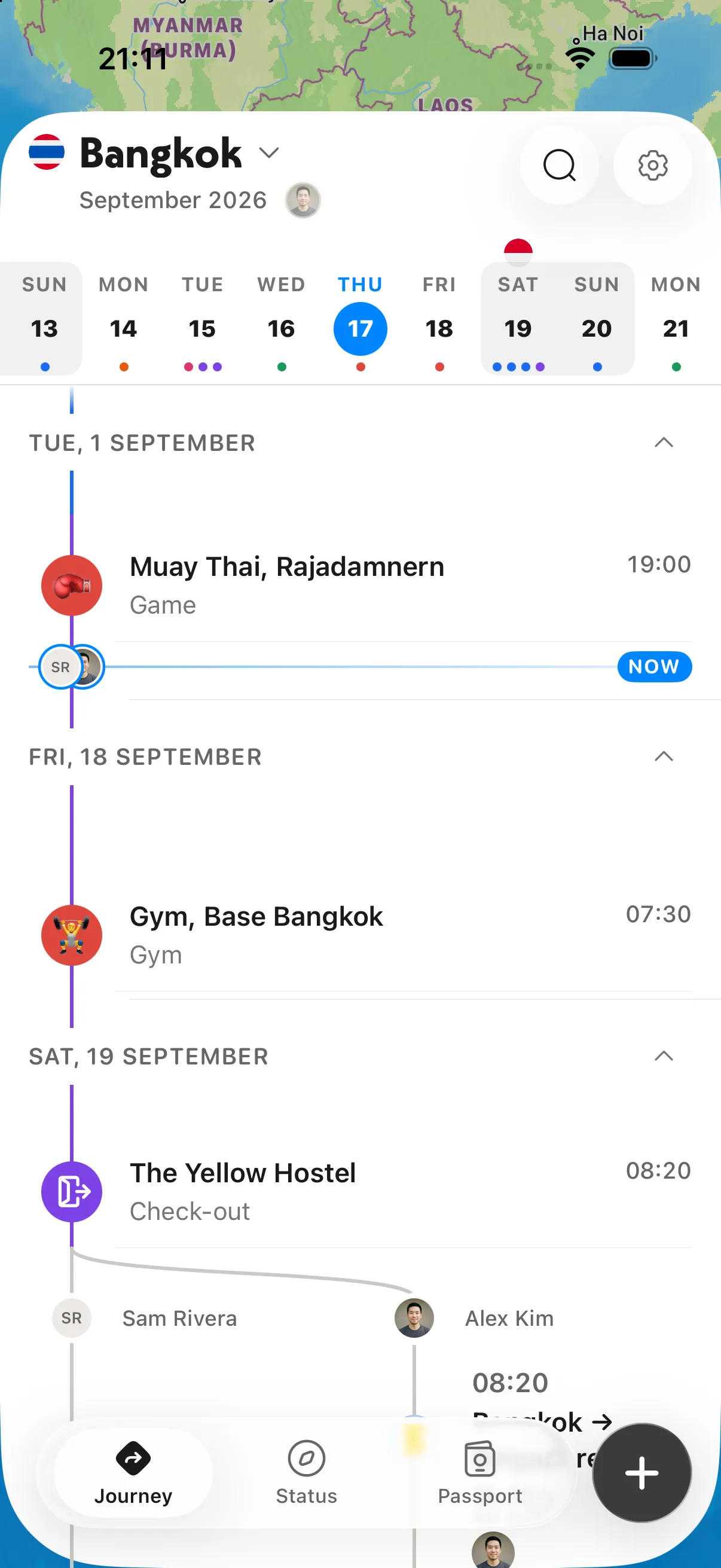
A NomadPoint screen with example data: one day of the itinerary.
The plan itself is free: unlimited journeys, the itinerary, entry rules and days left. Pro ($29.99 a year or $7.99 a month in the US) adds flight alerts, the Live Activity, and an alert before a visa or stay allowance runs out. If Vietnam is one stop on a longer trip, see our Southeast Asia backpacking route. For the general method, see the multi-city trip planner guide and the best app to organize a travel itinerary.
Frequently asked questions
Is four weeks enough to backpack Vietnam north to south?
Yes, for the route above. It's about 23 nights on the core stops, so there's slack for Sa Pa or the Mekong, or for a rained-off day on the central coast.
Should I go north to south or south to north?
Either direction works by train. Let the weather decide: reach the central coast outside October and November, when Da Nang averages its heaviest rain.
How do I book the Reunification Express?
On Vietnam Railways' own ticketing site, dsvn.vn, which lists the stations on this route, including Hanoi, Ninh Binh, Hue, Da Nang, Nha Trang and Saigon.
How long does the Vietnam e-visa last?
Up to 90 days, single or multiple entry, for 25 USD or 50 USD, according to evisa.gov.vn.
Plan the whole route in one journey. NomadPoint shows every city, train, flight and stay on one timeline and flags the nights and legs still missing. Free on iPhone, iPad and Mac.
NomadPoint Team
Written by nomads who've lived in 30+ countries. We build the tools we wish existed.