How to Beat Jet Lag: What Works and the Best Apps
How to avoid jet lag, based on CDC and NHS advice: what to do before, during and after the flight, how long it lasts, and which jet lag apps help.
 By Elad · Nov 23, 2026 · 6 min read
To beat jet lag, start shifting your sleep toward destination time a few days before you fly, get daylight at your destination, and switch to local bedtime as fast as you can. Keep naps short and go easy on alcohol and caffeine. Most people adjust within a few days.
An app helps with the planning side. NomadPoint (we make it) shows your flight times and, with Pro, the time-zone changes on your itinerary, so you can plan the first days around the shift. It is not a jet lag coach. For a personal light and sleep plan, use a dedicated app like Timeshifter next to it.
The short answer:
- Before: move bedtime 1 hour a day toward destination time, for 2 to 3 days.
- On the plane: drink water, walk around, sleep if it's night where you're going.
- After landing: go outside in daylight, sleep only at local night, keep naps to 20 to 30 minutes.
- Apps: NomadPoint for the trip plan, Timeshifter for a jet lag plan.
Facts below come from official pages checked on 23 November 2026.
What is jet lag?
The CDC calls jet lag "a sleep disorder caused by rapid travel across time zones" (CDC Yellow Book). Your body clock, the internal rhythm that tells you when to sleep and eat, is still on home time.
Symptoms the CDC lists include poor sleep, daytime sleepiness, trouble thinking clearly, feeling unwell and stomach problems. Its criteria count jet lag from a trip across at least two time zones.
How long does jet lag last?
The NHS says it "usually improves within a few days as your body adjusts" (NHS).
The CDC gives a rate: on average the body adapts about 1.5 hours a day flying west and 1 hour a day flying east. Flying east is harder, because you have to move your clock earlier. So as a rough guide, six time zones east can take about six days to fully catch up.
How to avoid jet lag: step by step
Before you fly
- Rest well. The NHS says to "get plenty of rest before you travel."
- Shift your sleep. For 2 to 3 days before, go to bed 1 hour earlier per day if you fly east, or 1 hour later if you fly west (CDC).
- Pick your arrival time if you can. The CDC suggests choosing a flight that lands when you'll get the right amount of light exposure.
On the plane
- Drink plenty of water and stretch or walk the cabin (NHS).
- Sleep if it's night at your destination.
- Limit alcohol. The CDC says it can help you fall asleep but breaks up sleep and adds to dehydration.
After you land
- Switch to local time for sleep "as quickly as possible" (NHS).
- Get outside in daylight. The NHS says natural light helps your body clock adjust. The CDC says the best time of day for light depends on which way you flew and how far.
- Keep naps short. The CDC says naps of 20 to 30 minutes can help you stay alert, and long naps make it harder to sleep at night.
- Don't overdo caffeine or alcohol. The NHS says both "can make jet lag worse."
The key takeaway: light and sleep timing do most of the work, and the right timing depends on your direction and the number of time zones.
What about melatonin?
Official sources disagree here. The CDC describes timed melatonin as a way to shift the body clock and says 0.5 to 1 mg is often enough. The NHS says melatonin is "not recommended on the NHS for jet lag because there's not enough evidence to show they work." Ask a doctor or pharmacist before you take it.
Jet lag apps compared
| NomadPoint | Timeshifter | |
|---|---|---|
| What it is | Trip planner | Jet lag plan |
| Personal light and sleep plan | No | Yes |
| Flights, stays and activities | Yes | Not listed |
| Time-zone changes on the itinerary | Yes (Pro) | Not listed |
| Delay and gate alerts | Yes (Pro) | Not listed |
| Price | Free, Pro $39.99/year | First plan free, then $9.99/plan or $24.99/year |
| Platforms | iPhone, iPad, Mac, Apple Watch | iPhone and Android |
Sources: NomadPoint pricing, Timeshifter, Timeshifter on the App Store.
1. NomadPoint: the trip plan the jet lag plan sits next to
NomadPoint holds the whole journey: flights, stays and activities, day by day. It checks the trip, flights, stays and borders, and warns you before something breaks. For jet lag, the useful part is seeing exactly when you leave and land.
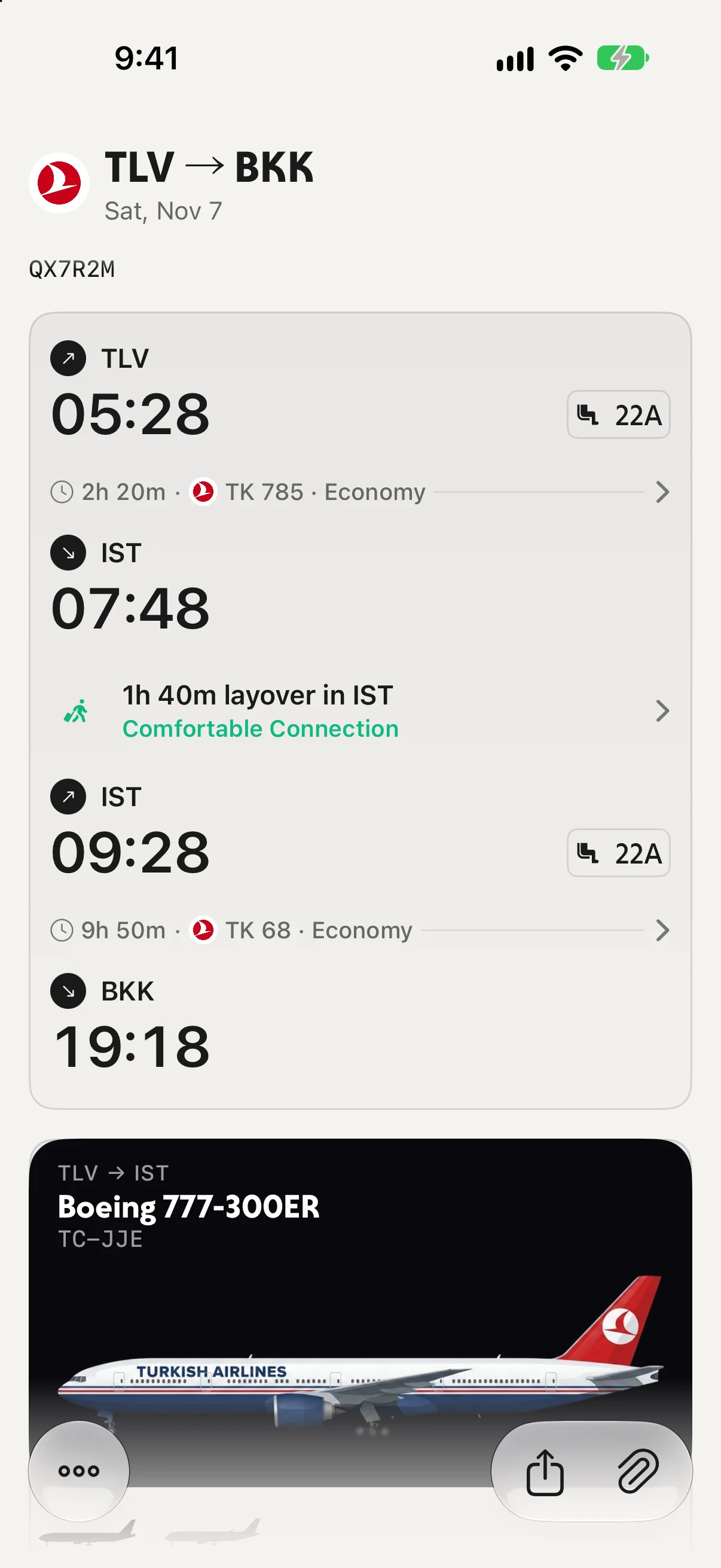
Both legs, with departure and arrival times and the layover between them.
With Pro, the itinerary shows time-zone changes, so you can see where the clock shifts and plan the days after you land around it: an easy first morning, or time outside in daylight.
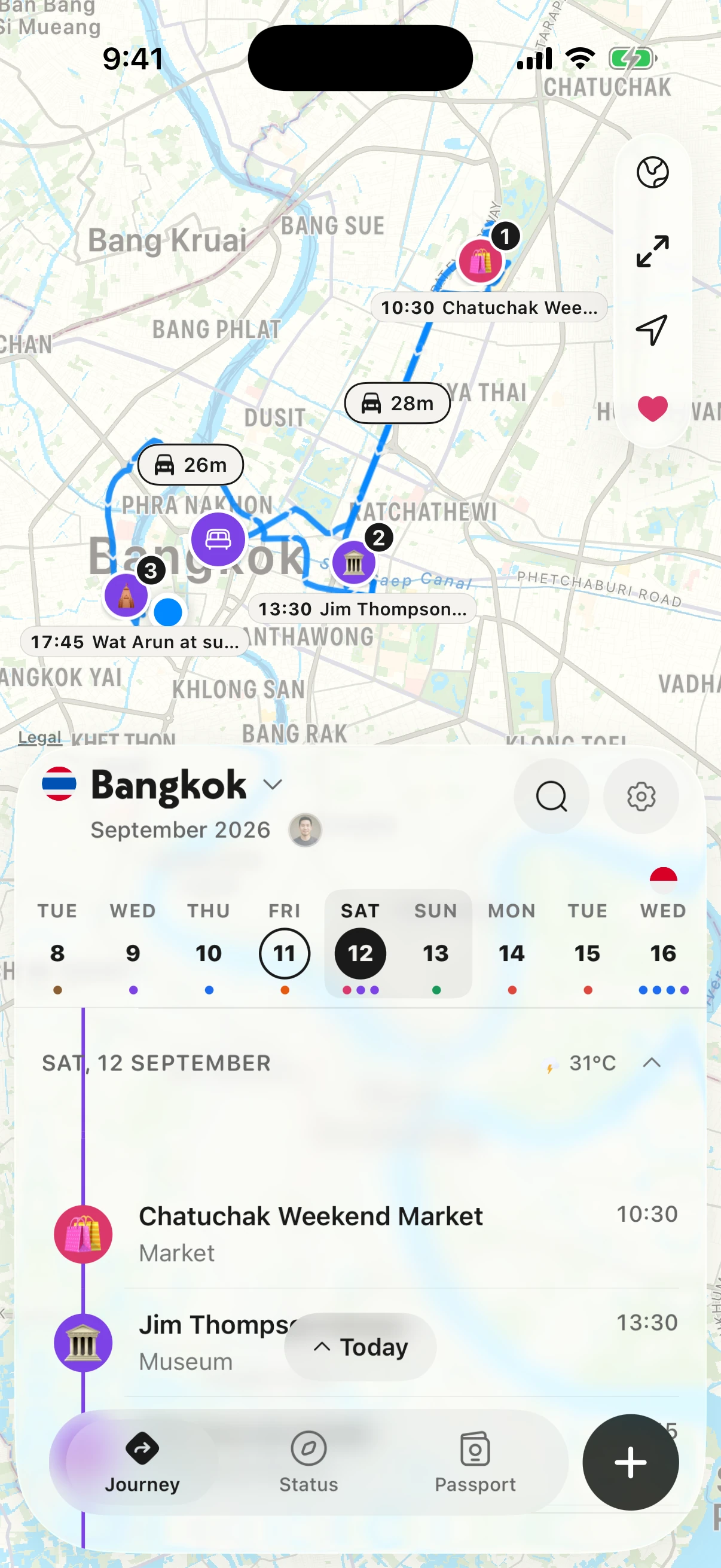
A day with a late-morning start, the stops on a map and the weather.
What NomadPoint doesn't do: it won't tell you when to seek or avoid light, or when to sleep. For that, use Timeshifter. With Pro you also get delay and gate alerts, so if a late flight moves your arrival, you know your new landing time early. See the best app to track flight delays.
The plan is free. NomadPoint Pro is $39.99 a year with a 7-day free trial, or $7.99 a month (pricing). It runs on iPhone, iPad, Mac and Apple Watch, not Android.
2. Timeshifter: a personal jet lag plan
Timeshifter builds a jet lag plan for your trip, based on "taking small actions at specific times." Its App Store listing says plans cover light exposure and avoidance, sleep and naps, with melatonin and caffeine advice optional (App Store).
Price, from Timeshifter: "First jet lag plan is free. Then, $9.99/plan or $24.99/year (unlimited plans)." Its site shows App Store and Google Play downloads, so it works on Android too. Timeshifter says it is featured in the CDC Yellow Book; the CDC chapter itself recommends using a "jet lag calculator" for personal timing, without naming one.
3. A jet lag calculator
A jet lag calculator works out when to get light, avoid light and sleep for a given trip. The CDC says to consider one "for individualized recommendations." Timeshifter is one, inside an app.
FAQ
What is the best jet lag app?
For the trip itself, NomadPoint: flights, stays and, with Pro, time-zone changes on the itinerary. For a personal light and sleep plan, Timeshifter. They do different jobs, and work well side by side.
Is there a free jet lag app?
Timeshifter's first jet lag plan is free, then $9.99 per plan or $24.99 a year. NomadPoint's trip planner is free; time-zone changes on the itinerary need Pro.
How long does jet lag last?
Usually a few days, says the NHS. The CDC puts adaptation at about 1 hour a day flying east and 1.5 hours a day flying west.
Is there an Apple Watch jet lag app?
Timeshifter's App Store listing doesn't mention an Apple Watch app. NomadPoint's Watch app shows your next flight and where you're staying, sent from your iPhone. See the best Apple Watch travel apps.
How do I recover from jet lag faster?
Switch to local sleep times right away, get daylight during the local day, keep naps to 20 to 30 minutes and limit alcohol. If you have a long connection, plan your layover too, and keep your boarding pass on your iPhone ready.
Plan the trip around the time change. NomadPoint holds your flights, stays and plans, and with Pro shows the time-zone changes day by day. Free to download.
Elad · Founder of NomadPoint
I build NomadPoint and write these guides. Spot something wrong or out of date? Write to me at support@nomadpoint.app.